Thursday, 3 November 2011

CTS - Marxism and Design Activism Lecture - 4

 Marxism and Design Activism

Aims:

Introduction of ideology
Introduction of the basic principles of Marxist philosophy
Explain to the extent to which the media constitutes us as subjects
Introduce 'Cultural jamming' and the idea of design activism - trend among activist designers

"The philopsohers have only interpreted the world, in various ways; the point, however, is to change is."
Marx, k. (1845) Theses on Feuerbach
There no point in just thinking without combining it without actions
To find some kind of synthesis between theory philopshy and thought and action

Marxism is:
  • Policitcal manifesto leading to socialism, commiunism and the twentieth century conflicts between capital and Labour.
  • A philosophical approach to the social sciences, which focuses on the tole of society in determining himan bahaviour, based on the concept of dilectical materialism
  • Revolutionary policatl movement

What is capitalism

Bourgeoisie, the commodity, proletariats

_ Control of the means of production in private hands
- Markete where labour lpower is bought and sold (inc humans - almost commodities)
- Production of commodities for sale 
- Use of money as a means of exchange
- Competition / meritocracy 
'Best suceed' etc 
Stature in society , to be at the top, its a competition

Communist evolution

  1. Primitive communism - hunter gather societys - co-operated at every level, no such thing as monogamous relationship (social and sexual freedom)
  2. Slave society - birth of aristocracy - Develops when the tribe be becomes a city state
  3. Feudalism - Aristocracy becomes the ruling class, merchant develop into capitalists
  4. capitalism - Ruling class, employ the real working class
  5. Socialism - Workers gain consciousness, overthrow the capitalists and take control over the state (revolution) 
  6. Communism - a classless and stateless society (never properly materialised)
Marx concept of base / super structure

Base (economic)

Forces of production - Materials, tools, workers, skills, etc
Relations of production - Employer, class, master, slave etc

Superstructure

Social institutions - Legal, political, cultural (art , design, education) Can be traced back to issues of class, gender/racial politics, everything bears this stamp
Forms of consciousness - Ideology

"The history of all hitherto existing society is the history of class struggles."

Capitalism (the society were in) produced laws, culture, law, politics, education which reflects the capitalist attitude

Base > Determines content and form of > super structure
> Superstructure > reflects form of legitimises> base
Educator > instrcuts (form of education)  Work > instructs (act although its normal, marxist reading into education)


Super structure > Education, family, religion, mass media, politics > Base - Relations of production, means of production

Super structure - maintains and legitimates the base
Base - Shapes the structure


Reading - Marx, (1857) "contribution to the critique of political economy' :

In conclusion:
Society produces our life's, not us, the accident of our birth produces what were are going to be. Where we are in life we are forced into relations and situations, these relations which reflect the society we live in. the base determines the superstructure, which determines our consciousness ( to rebel, to take it as normal etc) our society condition everything, philosophy, interaction etc. Social being dtermines our consciousness. Change the base> change our attitudes, arts and culture. 

1917 poster international workers of the world, pyramid of capitalist system.

The capitalism > 'We rule you'  king / queen > We fool you > religious statures > We shoot at you (Army) > We eat for you (upper class - bourgeoisie) > We feed all and work for all (workers)

control subjects in society - by ideology, controlling way they think
To set up an organised religion , e.g - religion teaches us how to think, is we're good and honourable, work hard for family, doesn't matter if were poor, as long as we're moral, to die and be rewarded in heaven. But your dead, so wheres the reward? Religion a trap - a form of mental control.

One can have an ideology, system of ideas and beliefs (e.g Christianity, conservatives) 
Ideology - The way in which a system of ideas masks, distorts a way of thinking about the world, which covers ove glass/gender/race discriminations. Legitimises over certain classes/races - false consciousness - exploited

Karl Marx (1846) ' [the ruling class has] To represent its interest as the cmoon interest of all members of society,...to give its dieas the form if universality, and represent them as the only rational, universally valid ones.

'Religion is the opiate of the masses' - Marx

Art as ideology
Only people who became artists, had money to be taught, rich people making art. Women not allowed to make art. White rich men making art. Who buys art? Kings / queens. dictate what is painted. How does it reflect interest of common man?
Modern time - Reflecting a certain ruling class thinks. We can be fooled to think this way.

'Guerrilla girls' 2007 and 1989

Althusser (1970) 'Ideology and ideological state apparatuses'

Society = economic, political and ideological. Mechanism to the way we live our lives.
Ideology is a practise which men and women 'live' their relations to real conditions of existence.
Ideology offers false, but seemingly true resolutions to social imbalance.
Ideology offers reasons why we are in our situation. E.g women - ogled - well actually, thats okay as women are more beautiful than men (art - studies perfect female form)

The media as ideology state apparatus
  • Means of production
  • Disseminates the views of the ruling class
  • Media creates false consciousness
  • The individual is produced by nature; the subject by culture. (fiske, 1992)
- The constitution of the subjects


Newspapers have ideological assumptions when approaching language to their target audience. The sun - working class people - talks of tv, uses slang etc. The times - political, literature etc.

Student riot articles - Headlines - not discussion, just opinion , assumption, ideological

Darcus Howe - BBC interview on London riots - Youtube

Ideology:
- System of beliefs
- Masking, distortion, selection of ideas, reinforce power relations
- False consciousness

'Men act and women appear. Men look at women. Women watch themselves being looked at. This determines not only most of the relations between men and women but also the relation of women to themselves' - Berger ways of seeing

Wonderbra adverts
"double major' 
'I cant cook, who cares' Patriarchal views - Women should automatically cook for men

Through buying, consuming we make ourselves poorer through buying, never gain status in society.

Commodity fetishism (marx, capital Vol.1)
Fetisise commodities
Something that gets in the way of something else, used as a substitute
Trainers taking appearance of 'cool' , you being 'cool' mediated by trainers

The assets of the worlds top three billionaires are greater than those of the poorest 600 million on the planets


'The life of Bryon'

'Occupy wall street'  Organised events / protests through media , twitter etc
These need visualisation 


Adbusters & cultural jamming
'Buy nothing day' etc
techniques - do something to a piece of work / object to alter message. E.g - `billborad - used to give a message - Distort this - its still a strong message.
Look at youtube videos


'Clean city law' banned advertising - Visual garbage


Monday, 31 October 2011

CTS Seminar - 1

Panopticism 


Key points from lecture


  • Conformity 
  • Being watched subconsciously makes you act in a certain way
  • Relies on surveillance , or at least that idea that you are always under surveillance
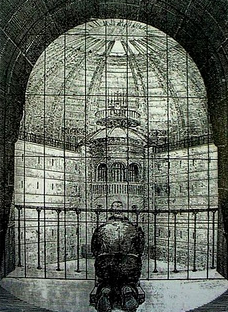
  • Panopticon - Jeremy Bentham 1791 (political philosopher) Design - not particularly for prison
  • Michel Foucault - Interested in the mechanism for discipline, Panopticon secluding people to be on their own, the way in which its a metaphor for the way society controls its citizens, an allergy of how we're controlled in our day to day lives. Panopticon symbolises our day to day lives. Figure for how we're controlled.
  • Panopticon
  1. Isolation - Your own thoughts an lack of influence from anyone else, to one to relate to, can't plot, can't misbehave, gossip, stop working. IT begins the process of you internalising mentally of self discipline. The feeling of individualisation and isolation.
  2. Visibility - Unknown if someone's watching. Backlit. They are permanently lit, visible, puts them on display. The watcher visible.
  3. Behaviour and self control - Doesn't need anyone to exercise power over someone else, once internalised that your isolated, permanently visible, you conform to a set of idea that you think the person watching you wants to behave like. You start to control yourself.
  4. Surveillance
  5. Society - Shift from methods of physical control to much more subtle mental methods of control. Use of Asylum is where shift begins. Asylum - treats given as rewards, coersed subtly. First (ish) instance of modern disciplinary submerge. More effective to train people to behave than 'make' them.
  6. Physical control > Mental control (doesn't make it more humane) Old ways didn't correct the defects of people. Panopticon trains, and alters behaviour.
  7. Productive - e.g School - Panoptic system - makes children work harder, more focused. e.g Prison - Produces a form of behaviour in a person. E.g - Hospital - stop people spreading disease.
  8. Making people control themselves - Self regulation (as said by Foucault) 
  9. Power - The power to control or exercise - Power is a relationship that we enter into willingly, Foucault thinks its a fiction that people have to use of someone else. Marxism and feminism - " theres a rule and class, in which the higher have power over the poor' ' Society is patriarchal, in which men have power over women' - Foucault - power only exists because a person lets themselves be exploited by such power. Panopticon - prisoners being exploited, people choosing to be controlled by tower, isolation etc to behave a certain way. Always a possibility of resistance (a lot of the time we don't see this opportunity and just conform).
  10. Panopticon makes your conform to the expected behaviour by the system, it disindivudualises the power relation - you never know the guard watching you, no personal relationship. Institutional gaze - e.g prison - act like the institution of law would want you to act like.
  11. For panopticism to work, there must always be a physical reminder. You can't be oblivious to it, otherwise it wouldn't work. E.g - Speed cameras - Visual reminder, may not even have a camera in. You become so trained you react to such visual reminders, and think nothing of it. Foucualts opinion - perfectly trained individual - 'Docile body'. Someone who won't resist and will conform. You don't question anything, you just act in a way.
  12. Method of control of supervised and supervisor. 


Reading from Michel Foucault


Tasks: Analyse a piece within society which is panoptic (will be on blog)


Write about 300words - Choose some aspect of contemporary society which you think is panoptic / has a panoptic mechanism (e.g cctv) Polished piece of critical writing. Use technical terminology e.g docile body, self regulation. Weave five quotes from given text into the writing. Choose a fragment of a sentence to weave into my own writing. Don't skim read, read, read again, underline, use markers in margins etc. Highlight words I don't understand to look up later.
  • CCTV (fake?) Fake security camera - LED light, to make it look like its working
  • Speed cameras (is there even a camera in it)
  • Suburban street - Houses facing onto road - can be seen by everyone, your garden can be seen my neighbours, feel the need to improve it. Feel its for their own pleasure - they're actually doing it as there aware someone is looking at it, to impress others.
  • Open flan
  • Teachers computer history is available.
Read and highlight given hand out - make notes 'Michel Foucault' - Panopticism 
Makes notes on already highlighted areas


Bibliography to looks at - Michel Foucault - 'History of sexuality'


.....


TASK ONE


Response to task:


Subject matter: Modern technologies releasing your location


Quotations to use from 'Panoptism' handout by Michel Foucault


Plague; understood as a metaphor of social disorder; Foucault explains societies response to the threat of the plague as: 'a surveillance system of permanent registration: reports', a physical form of panopticism. Modern technologies, such as 'Google Maps' and Facebooks 'Places' app, allow us to invade others, to gain knowledge of their location, to subtly gain control unbeknown to the person, 'He is seen, but he does not see; he is the object'. As opposed to the panopticon, the 'inmate will constantly have before his eye the tall outline of the central tower', thus knowing they are possibly being watched upon, more so than those subject of such digital programs in the modern online age. We know such programs exist , but become, as Foucault describes as a 'Docile body', in conforming; allowing such information from being withheld; lacking to respond to such exploit of our privacy, becoming unresponsive, we fail to actually think about the affect such information could have in the hands of another, to ourselves.


Using the 'places' app; To give your 'Facebook friends' knowledge of your location, as a method of gaining feedback, to find and converse with others who find themselves within the same area. We fail to realise (Again relating to docility) the 'place' is released on the 'News feed' for all to see, it's become panoptic, 'Visibility is a trap'; the illusion to be open with your location, is some how protective, is a myth. It's a danger, once such information is realeased, you can't hide. In regard to 'Google maps', once an subject knows of your postcode, street, or city, it can be searched and looked upon. A panoptic view of someones house can be seen through a 'street view' option, it is a 'constant visability' to others. Such technologies are becoming panoptic and an intrusion to our privacy, yet, we don't react to it. For panopticism to work, there needs to be a physical reminder; the 'google maps' application works through word of mouth, through societys reliance on the internet. When visiting a new place, many of us immediately think to use the program, to then tell others the method in which we found the 'place', so there is a constant reminder of the ease of the programs use. 


Thursday, 20 October 2011

Lecture - Technology will liberate us


CTS lecture - "Technology will liberate us" - Joanna Geldard

Art and its emergence with design in and through technology
What are the implications of technology on our design

Technological conditions can effect the collective consciousness. Technology can trigger important changes in cultural development.

Walter Benjamins essay - 'The work of art in the age of mechanical reproduction " (1936)

Technology - An instrument for change


A work in its own right , or an image representation of the of the original.

Machine age; Modernism

Walter Benjamin + Mechanical reproduction
- The age of technology and art
- Parallel and specific to new developments ; a duality expressing the zeibeist 
- Dialectical due to copy, reproductive nature and the role of the original
- The aura and uniqueness of art
"Not as good as the original"

Photography at beginning of relation between art and design
John Berger - Looks at Benjamins essay - Thoughts and critiques on photography

'Dziga Vertov' man with a movie camera
'The camera eye has a variable gaze' - camera eye represents technological eye and progress.

Photograms - Early experiments with photography and technology

Benjamin and two parallels Freud and Marx

Photography had overturned the judgement seat of art - a fact which the discourse of modernism found hard to repress
(Lovejoy Pg 36)

Once art and design enter consumerism the values can be distorted

Original may be valued, but copy in reproduction and consumerism can make it become more valuable

Modernism - Stability
Post Modernism - Not stable

Freud - Exploring what the material aspects of technology no terms of how it can express our subconscious.

Film and virtual reality - how it plays with the subconscious

Kineticism - Capturing movement with photography 
1888 successful movements of human
Krono - photography - When we represent time and movement

Dematerialisation of art
One you look at a movement image, from a video - its now just an image, a copy, reproduction which has been transformed

Richard Hamilton - DaDa movement, photography duplication
Using technology to create an image
'Just what is it that makes today homes so different, so appealing.'
Art and Design merging together distorted and styled in context of Art and Design.
Convergence

Karl Marx and technology 
Assocoiated with the technological determinism - How it determines economical production factors and affects social conditions

The relationship of technological enterprise to other aspects of human activity

Alienation

Dialectical issues
- Technology drives history
- Technology and the division of labour
- Materialistic view of history
- Technology and capitalism and production
- Social alienation of people from aspects of their human nature as a result of capitalism


Electronic age: Post modernism
- Many electric works were still made with modern aesthetics
- Emergence of information and conceptual based work
- The computer a natural metaphor
- A spirit of openness to industrial techniques
- Collaborations between art and science

We consume technologies and new techniques

Because of collaboration between technology and industry , creates collaborations between art and science.
Seeps across boundaries - Result of technology
Computer allows art to go across other forms and contexts

Chalayan
Falling/falling , multimedia installation by Douglas Rosenberg (1998) Video become a form, object, installation

Venous Flow, states of graces performance still collaboration between Douglas Roasenberg and Li  Chiao - ping

Lori Anderson - video work (70s) Viophoneography music/video/performance/installation

' I will not make any more boring art ' Defaced and burnt artwork

Sumulation and simulacrum 
The reflection of profound reality
Makes and denatures a profound reality
Makes the absence of a profound reality
Copy of a copy of a copy
It has no relation to any reality whatsoever; it is its own pure pure simulacrum
Jean Beauddrillard (1981)

Copy of an object becomes a form in its own right.

Hyper reality
Boundaries blurred between copy and original
Seen as real / understood as real
Fantasm - illusion to what is real
Word of mouth - take it as real, it masks original truth

Nam june pek
Panopticism - who is the  viewer, person of power, illusion of power

John `Walker and Art and mass media 2001 e.g Andy Warhol
The artist as media celebrity art in advertisement
Marylin Monroe Dublication - no longer art - Used in Design now

Design Age
- Digital potential leads to multimedia production
- Technological reproduction of all images so they are addressed by the computer
- New Contexts
'Blue tilt' 
Baltic flour mill - Gateshead Projection
Frank Giilette - Monkeys Birthday

The human race machine

Multimedia work
- interactivity 
- Performance 
-  Transdiciplinary
- time, space and motion explored in art use art
- Collaboration 
- Computer as a tool of integrating that media

Hyperreal ; reality by proxy bank

To conclude
Art comment on the ideology of everyday life.
Art can be expressive or progressive
Technological tools can blur the line between production of fine art works and commercial and design productions.

Thursday, 13 October 2011

Panopticism - Lecture One

Panopticism
Institutions and institutional power

Notes taken in lecture


The panopticon design. Made so each cell holds a prisoner. The central tower, the guards accommodate, the tower unlit so whether there were guards in there or not, was un recognisable to prisoners. To there knowledge they were being watched 24 / 7. It was a mental state. Prisoners, not knowing this, would behave.


The pillory, a public humiliation torture device. Shoiwng society what would happen if they behaved in a way outside of the 'norm'.

A modern panopticon prision

A modern panopticon, the Brotherton reading library within Leeds university. Designed for the purpose of giving each student the space to read in peace, it in fact breaks apart the students, blocking them from seeing one another. Librarians and teachers have the ability to see what everyone is doing within the library.


Vito Acconci 'following piece'

Monday, 28 March 2011

ADVERTISING ESSAY - Take two - Restructured

Stephanie Lawson - CTS Essay

'Advertising doesn't sell things; all advertising does is change the way people think or feel' (Jeremy Bullmore). Evaluate this statement with reference to critical theories (past and present)

Here Bullmore explains its not the adverts themselves selling a product, but the impact they have on a person, for instance, Images used to trigger personal experience or to reference, in such a way to evoke emotion for us to either feel, or to feel for others. Words are inevitable in conveying a message or an opinion.  

Advertising, as a medium has become more than just to promote a product, a more personal factor within this selling method is the sole reason we buy a product; selling a lifestyle as an instance, is a common subtle message used.

With her book, 'Decoding advertisements', Judith Williamson explored and analyses what can be 'seen' in advertisements. Believing it's an "inevitable part of everyone’s lives…" stating that you don't even have to be 'directly involved in the media, it's all around us". That image within our urban surroundings are 'inescapable'. She states that advertisements have their own independent reality, becoming separate from the material medium, which carries it. She agrees that its main function is to sell things, but that it has another, to create structures of meaning. In order to sell us something advertisers make the properties of a product 'mean' and connote something to us.
She suggests that advertisements provide structure, transforming the language of objects to that of people.
"Advertising sets up connections between certain types of consumers and certain products."
Using signifiers and what is signified to create the connection. "Taking the sign for what it signifies, the thing for the feeling." (Williamson, J, 'Decoding advertisements', 1978). She also believes people and objects are interchangeable. Advertising is selling more than just the goods, but by providing a structure, in which they are interchangeable, are selling people, themselves.
"People are identified by what they consume rather than what they produce."
We are no longer an image of our skills but by our materials and commodities. She states we are made to believe we can rise or fall within society by what we can afford, and can't, obscuring actual class basis. Class difference has lost meaning. Apparently we can now purchase our place in society. As we feel a need to belong, the mass media provide this 'Place to belong' to an extent.

In this commodity culture, people buy products to enhance appearance, thus to give then a false illusion of a better and wealthier lifestyle; to many, this is a must, some people 'Can't afford not to be glamorous' (John Berger, 1972).  Of course, by spending the money in the first place, it does in fact, make us poorer, thus destroying the reason for purchasing the product initially; Berger argues that publicity persuades us in this consumerist society, that, by spending money we change ourselves or our lives, by buying something more. This 'More' will make us richer. Even though, it will in fact, make us poorer.

We are not able to escape the mass amount of adverts our society is exposed to in our day to day life their inescapable. Within the series 'Ways of seeing' (John Berger,1972)  expresses and evaluates his opinion of advertising and the world it has created:
"It's a language of words and images which calls out to us, wherever we go, what ever we read, where ever we are." 
Believing advertising throughout its variations and selection of mediums are becoming inescapable.

Such an example of Judith Williamsons theory  of advertising setting up connections between consumers and products this is commonly seen within men’s aftershave television adverts; 'Lynx', due to its adverts, connotes popularity, sexual appeal, youth and a level of attractiveness.

A recent advert of a new product for 'Lynx' is called the 'bullet', with the slogan 'pocket pulling power'. In simple terms, its a travel size, lynx spray, but due to its size, it now has a new use, the idea of taking it to a night club and dousing yourself in this 'pocket pulling power' is seen within the advert; a man sprays himself and is suddenly found attractive and desireable by beautiful women. An example of advertising selling a lifestyle, referencing age group, night life, sexuality, gender, directing it solely at its targeted audience of young males, who are 'out on the pull' possibly wanting some sexual activity. It’s symbolic assumptions is the selling tool for this product, and we as an audience are full of assumptions, that if we don't have this particular product, we won't have what it connotes. 


Within a consumerist society, we are impaled by constructed false needs. This, not just with 'Lynx', but with so many products, women's fashion and makeup, I feel to be a huge instance of this. "People are identified by what they consume rather than what they produce.", Williamson, J, Decoding Advertisements believes in this theory. Commodity culture perpetuates false needs for meaningless things; if we see a promoting, new make up, which has a celebrity endorsement of someone we as a society either look up to, find attractive or envy, by using this 'new and improved' brand, we immediately feel a need to purchase the product, even if we already have it, in a possibly cheaper, or less renowned brand. It creates the false message that it will give you wealth, what the celebrity itself connotes and sexuality within an idealized lifestyle. It sells us the promise of an improved version of your life through commodities, celebrity endorsement and connotations. 

Another example of this is a recent, controversial advert for Beyonce’s ‘First fragrance ‘ ‘Heat’. Initially a television advert, but banned during the day because of it’s explicit nature, has become a viral advertisement. It consists of Beyonce expressing herself in a sexualized way, dressed in a very small, red velvet dress in a dark, steamy room; possibly simulating a sex scene. She simply walks through showing a lot of cleavage, and is apparently the source of heat, her very foot steps creating smoke and her hands creating fire. She seems to stroke, and stimulate herself. This heat, making her sultry.

The colour red dominates the advert. Here Williamsons theory is apparent, the signifier is red, which signifies sexuality, heat, a level of irresistibility. Setting up a connection between certain types of consumers and certain products. Women want what this product signifies, as men find her particularly ‘sexual’. Women want what she connotes, and feel without this perfume, an inability to do so. As Williamson explains, to sell us a product, it has to have a meaning to us. In this case it’s the sexual desire that Beyonce holds, wearing this perfume. It portrays a message to women that, like Berger specified, you feel you can’t afford not to have this perfume, not to be sensual and like Beyonce; a sexualized object of desire. This advert sells us a lifestyle, one including a frequent, erotic sex life. It doesn’t directly sell the product at hand, but through meaning. Williamson tells us of a link between product and person, saying they are interchangeable, which I believe to be proven in this advert.  

            There has been a massive impact of advertising through the use of new media, techniques and solutions, there is such a variation now, and it’s hard to depict categories for each. Voluntary viewing within websites like ‘Youtube’ gives a whole new outlook on advertising, video's can be uploaded and watched for free. Now people can now choose to watch an advert, rather than being forced to view them when walking through a street or watching television. It can be emotionally stimulating, an example of this is a recent video called ' Embrace Life", can be viewed on 'Youtube'. It promotes the use of seat belts, through its emotionally evoking video, used alongside with a quite powerful and moving sound track. The impact it has is strong due to it's medium. It's not conveying the message that wearing a seatbelt is a 'rule', it's soft in it's approach, using a child like acting of a car crash, and a family, human made seat belt to show the impact such an event could have. The use of high culture (acting as an art form), video, screen, being able to relate to the actors, and choice viewing really is the creation of something new and interesting, never seen before, together. It could be argued that it is a modernist medium of advertising, conveying the message that they are trying to do what hasn't done before. In some sense, a merging of many variations and methods of advertising in order to create something new from the old; a bricolage form of advertising.

The reaction of Viral advertising is immense. The way in which millions see a video, which begins with just one person sharing it with another, for this to be passed onto several, to dozens to hundreds and so on. Target audience is no longer an issue in which television advertisements have a problem with. It you don't watch a particular channel, the chances of you seeing an advert on there, are slim. But in this generation many own a computer and billions use the Internet daily, and for those who don't, word of mouth will likely get around to them. Viral advertising is becoming a very powerful tool, even more so with the range in which one can advertise itself. Peer to peer sharing is a method in which the video maker had the intent of advertising the product at hand.

Viral advertising could be argued, because of its viewing location and circumstances, can be so emotionally directed and engaging, that it's possibly one of the strongest form of advertising in this post modern era. But like all forms of advertising, with out its particular messages to evoke emotion, its triggering of personal experience, or to reference or connote, it wouldn't change the way we feel, we wouldn't live in a consumerist society. If all of this wasn't in affect, advertising wouldn't be what it is today, and it's methods, just wouldn't work. 


All elements of advertising are created and designed in a way a person will react and designed in a way a person will react and respond to it; whether that be shocking or eye opening. Colours, typography and image on their own, connote one thing but together can suggest a whole new meaning and message. They create something we all want or envy to be. A somewhat 'bragging approach' evoking jealousy and unrealistic wants and desires, and we, believe it achievable through commodities. 
            With new approaches to advertising becoming more personal and direct with their audiences, and with message becoming more controversial and responsive, advertising as a medium is growing it it's effect on society and the people within it.


Word count: 1687


Bibliography

Williamson, J, 1984, ‘Decoding Advertisements’, paperback
Berger, J, 1972, ‘Ways of seeing’, Final episode
Arvidsson, A, 2008,  ‘The logic of brand’
Arvidsson, A, 2005, ‘Brands: Meaning and value in media culture’
Adam Arvidsson, 2007, ‘The logic of brand’ [Online] available at: http://www.scribd.com/doc/110246/The-Logic-of-the-Brand-by-Adam-Arvidsson
Britney Spear's pepsi commercial, 2006, [online] Available at: http://www.youtube.com/watch?v=aYywiQ3-6To
Ways of seeing, 2008, John Berger, [Online] Available at: http://www.youtube.com/watch?v=mmgGT3th_oI
Loreal Advert by Beyonce, 2007, [Online] Available at: http://www.youtube.com/watch?v=xwLGsg0yPjw